
This is an article from the Baaz Transition Guide. Read it online!
Organizations that take this transition seriously and dare to make choices today are not only building competitive advantage but also future-proofing themselves. And that starts with more than just technology. Maaike Voeten from Textmetrics tells us more.
AI as a driver of transformation, but who is actually in charge?
AI is not an additional software package that you place somewhere in a department. It is a fundamental force that determines how processes unfold, how decisions are made, and how organizations develop. Yet, in many Dutch companies, it is still unclear who is ultimately responsible for AI. Is it IT? Compliance? Or management?
The answer, as Textmetrics also emphasizes, is: all of them. AI affects every layer of the organization and therefore requires widely supported governance.
'AI is not a technical toy for IT, but a strategic theme that belongs in the boardroom,' says Maaike Voeten, CEO of Textmetrics. 'Once you use AI for, for example, recruitment or communication, you touch on issues like inclusivity, ethics, and brand reputation. You simply cannot afford to have no governance in place.'
An AI governance framework provides clear guidelines and responsibilities, for assessment on ethics, transparency, safety, and legislation. But it also offers space: space to innovate without falling into legal or reputational risks.
The Netherlands vs. the US: a cultural difference that will hurt
When you look at the United States, you see a different pace. Tech companies like OpenAI, Google, Microsoft, and start-ups with millions in venture capital are building new applications daily. But traditional companies, from insurers to logistics, are also experimenting extensively with AI solutions. In many cases, AI teams have now become a fixed part of the corporate structure, and experiments are not on the periphery but at the heart of the organization.
In the Netherlands, we see a different attitude. Cautious, waiting, risk-averse. Sometimes this is justified. After all, AI raises significant ethical questions. However, it often works paralyzing. The fear of making mistakes should not be a reason to remain stagnant. Because while we plan pilots, others are achieving results.
'In Europe, the focus is rightly on ethics and control, but the danger is that we thereby block innovation,' says Koen Brummelhuis, CTO of Textmetrics. 'The challenge is to let governance and progress go hand in hand. Waiting for perfect frameworks is not a strategy. Learning while you implement is.'
The forgotten half of AI governance: who checks the input?
In many organizations, the focus is on control afterward: assessing generated texts, screening output for bias or errors, checking against brand guidelines. But in doing so, we miss a crucial step: the input that drives AI systems. Prompts, or the commands we give to AI, largely determine the quality, relevance, and safety of the output. Yet, in most AI governance models, there is still a lack of a structured approach to assess or document these prompts.
'Prompting is the new programming language,' says Koen. 'If you don't know what is being asked, you can't assess whether the answer is desirable. Therefore, prompt quality and management must be part of your AI policy.'
For example, anyone who includes sensitive data in prompts without realizing that this data is processed through an external AI service may inadvertently violate privacy regulations. And anyone who unknowingly uses leading or biased language will receive output that builds on that. AI governance must therefore not only intervene afterward but must ensure clear frameworks, guidelines, and training for responsible prompt use from the outset.

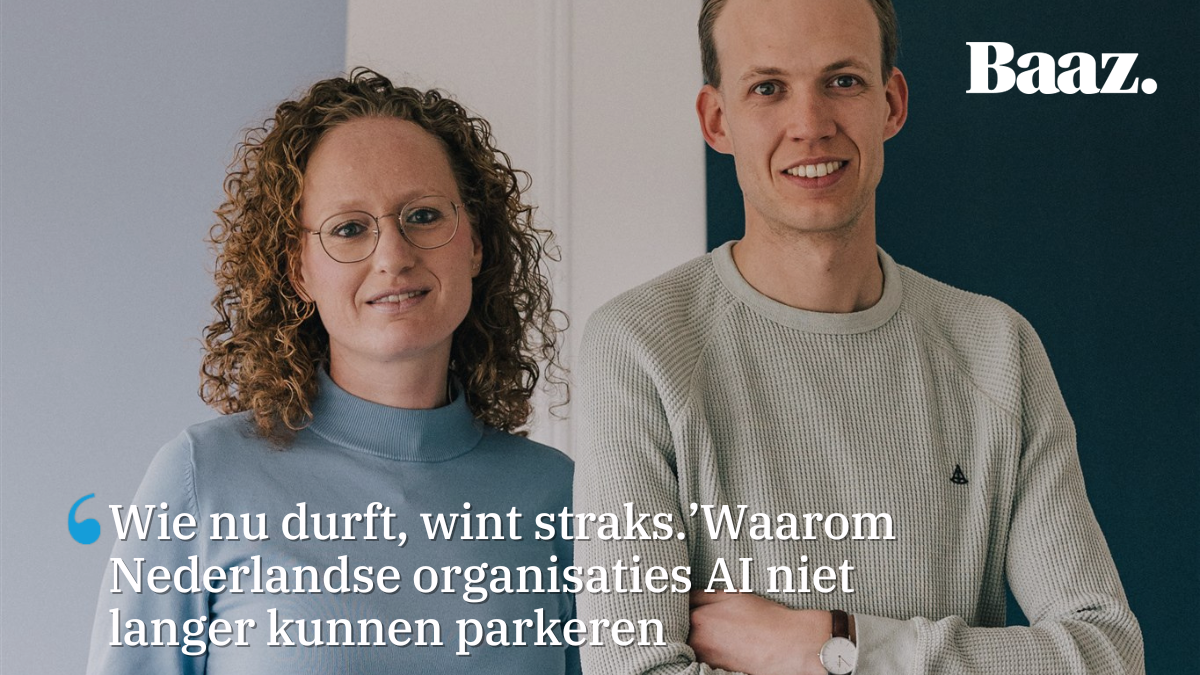
Maaike Voeten and Koen Brummelhuis
How Nationale-Nederlanden applies AI in content creation
At Textmetrics, we work daily with organizations that want to deploy AI and language technology in a way that truly works in practice. Often, these are companies with many content creators spread across different teams. Often all facing the same challenge: how do you remain consistent, understandable, and inclusive when writing a brand story with fifty people?
A great example of this is Nationale-Nederlanden.
What started as a pilot to make content more understandable grew into an organization-wide approach where Textmetrics is structurally used to make all external content accessible. Thus, all content is in line with the European accessibility legislation (EAA) that comes into effect on June 28, 2025.
Content teams receive real-time feedback on readability, inclusivity, and tone or voice, and aim for B1 level. The result: more and more content meets legal requirements and aligns with the brand story.
'We work in a decentralized content organization with many people on content. Textmetrics helps us to write as one brand: understandable, inclusive, and accessible to everyone,' says Nationale-Nederlanden.
This approach shows that AI does not have to be a separate experiment but can be a concrete support in structural changes. Whether you are working on inclusive job descriptions, accessible customer communication, or consistent brand language: with the right tools, frameworks, and involvement, you can make a difference.

Organizations must choose who they want to be
We are not facing a technological upgrade, but a fundamental organizational change. The deployment of AI touches on culture, leadership, structure, and even identity.
If we want to remain relevant as Dutch organizations, we must not only adapt but dare to give direction.
The question is not: when is the moment to start working with AI? The question is: have you done something today that makes your organization smarter than yesterday?
Three steps to stay ahead
How do you ensure that your organization does not lag behind but actually leads? A successful AI transition starts with three concrete steps:
1. Create ownership
Assemble a multidisciplinary AI governance team. Including IT, legal, HR, marketing, and management. Make it clear who is responsible for what.
2. Start small, learn fast
Begin with one process. Start with recruitment, then customer contact, internal communication, and so on. Experiment with an AI tool. Evaluate the impact, adjust, and learn.
3. Anchor ethics and transparency
Formulate ethical guidelines. Be open about where and how AI is being used. Transparency is not only mandatory; it is crucial for the trust of employees and customers.
Want to know more about AI? Then also read how to protect AI investments with smart security or check out our latest magazine, All About AI!