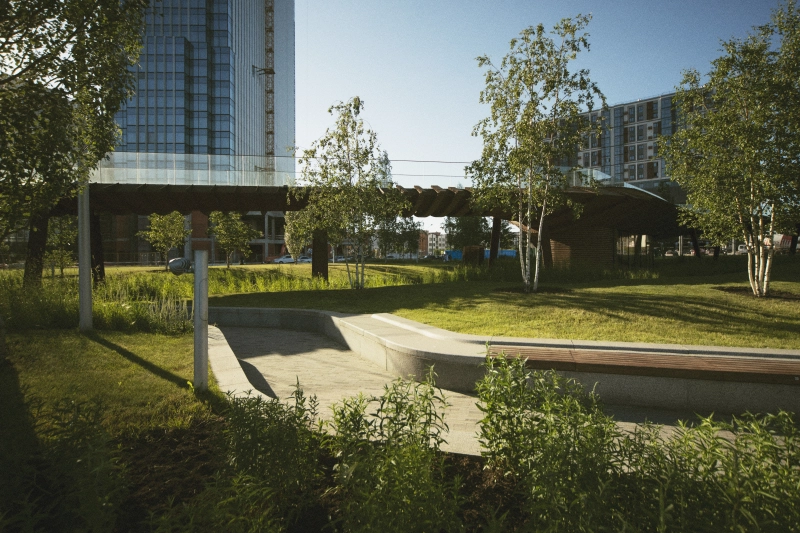

More and more companies want to ensure greening on their site, despite setbacks, and this is not a trivial trend. Green spaces on and around the company building provide tangible benefits for employees, visitors, and the organization itself.
Why green is a strategic choice
A greener business site contributes to multiple business goals at once. First and foremost is the well-being of employees. Research shows that a green work environment reduces stress, promotes concentration, and can decrease absenteeism. This directly translates into productivity and engagement.
Additionally, appearance plays an increasingly important role. Customers, partners, and potential employees not only pay attention to what a company does but also how it presents itself. A well-maintained, green site radiates sustainability, forward-thinking, and professionalism. Especially in a time when ESG and corporate social responsibility are increasingly taken into account, this is no detail.
Finally, there are also practical and financial benefits. Greenery helps with water drainage during heavy rains, reduces heat stress in the summer, and can limit maintenance costs in the long term. In some municipalities, subsidies or tax schemes are also available for greening and climate adaptation on your site.
In what forms can greening take place on your site?
Greening means more than "just putting down a few plants." There are various forms that fit different types of sites and budgets.
Green outdoor space
The most obvious option is to create greenery at ground level. Think of trees, shrubs, lawns, or flower borders. This can be functionally used, for example, as a separation between parking spaces or as a green pathway leading to the entrance. It is also ideal for company or networking drinks - in the summer, of course.
Green parking lots
Parking lots often cover a large part of the area. By opting for permeable paving, grass concrete tiles, or water-permeable pavement, the function remains intact while rainwater is better absorbed and the site looks less "concreted."
Facade and roof greenery
When space is limited, facades and roofs offer a solution. Green facades not only improve appearance but also contribute to insulation and air quality. Green roofs reduce heat stress and capture rainwater, which lowers the pressure on the sewer system.
Nature-inclusive elements
More and more companies are integrating biodiversity into their site. Think of insect hotels, birdhouses, native planting, or small swales for water capture. This aligns with broader sustainability goals and often requires less maintenance than neatly manicured green spaces.

Greening an existing site
Even without large-scale renovations, steps can be taken. It starts with an inventory: how much space is there, which areas are fully paved, and where are the opportunities? Often there are "forgotten" strips or oversized driveways that can easily be greened.
A practical approach consists of three steps:
 
- Start small, choose strategically. Begin with visible areas, such as the entrance or employee routes. This quickly yields results and creates support within the organization.
- Link greenery to function. Greenery works best when it serves multiple purposes: shade in parking lots, water capture during heavy rain, or noise reduction along busy roads.
- Think ahead in maintenance. Choose planting that fits the location and maintenance level. Native species are often more robust and require less care, which limits costs and effort.
More than an aesthetic intervention
Greening a site always provides an aesthetic upgrade, but it is also an investment in the future of the organization. It touches on themes such as vitality, sustainability, climate adaptation, and employer responsibility. Moreover, outdoor spaces are increasingly seen as an extension of the workplace: a place to meet, take breaks, or step away from the screen for a moment.
Companies that are already responding to this are ahead of regulations, stakeholder expectations, and changing work cultures. Greenery is thus not only an environmentally friendly choice but also a strategic one.