
From our editorial team
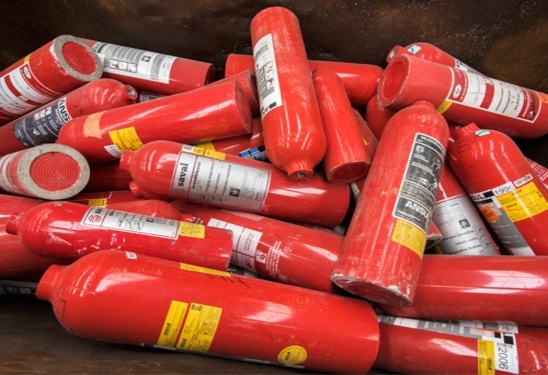
While heavy industries such as Tata Steel and Chemcours can emit harmful PFAS almost unhindered by authorities, a tiny family business in Lelystad is being put through the wringer by the Environmental Service. Not because it emits PFAS. But because the recycling specialist extracts the dangerous substance from fire extinguishers and processes it safely. And thus provides a service to society.
Nevertheless, the family business Eerste Lelystadse Schroothandel (ELS) is in the sights of regional regulators after the Environmental Service Flevoland, Gooi and Vechtstreek (OFGV) discovered PFAS in a soil sample taken on the premises a few years ago. This led to years of tug-of-war over the source of the pollution. ELS wants broader research, but the environmental service refuses. This puts the company in a deadlock as the true nature of the pollution cannot be revealed. ELS is appealing to provincial politics to break this impasse.
Black Pete
Fire extinguisher recycler ELS from Lelystad is fed up with always being blamed for the PFAS pollution. The environmental service has only measured on the premises of ELS. Not outside at other companies. This while research by internationally renowned PFAS expert Prof. Dr. Jacob de Boer shows that the pollution cannot scientifically originate from ELS.
'However, the Environmental Service refuses to measure in other locations. Which is very strange because as a government, you have a duty to seek the truth,' says Arjan van 't Wel, general director of Eerste Lelystadse Schroothandel (ELS).
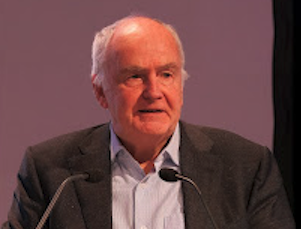
Prof. Dr. Jacob de Boer
This is confirmed by Prof. Dr. Jacob de Boer. De Boer is one of the most authoritative experts on PFAS in Europe. As an expert, he has also been appointed by the Secretary of State for Infrastructure and Water Management as a member of the Health Expert Group IJmond to advise on health in that region around Tata Steel. After this summer, a book by him will be published on the societal discussion about PFAS and other toxins.
Recognizable DNA
De Boer looks as a scientist at patterns in chemical substances, among other things. Each source of pollution has its own chemical profile. You can compare that to DNA. Pollution with a certain type of PFAS leaves a recognizable pattern. And that is where the problem lies in Lelystad, according to De Boer.
De Boer: 'This pollution cannot originate from fire extinguishers. The characteristics of the PFAS found in the soil do not match those from firefighting foam. Moreover, a fire extinguisher contains a relatively small amount of PFAS. In one extinguisher, there are only a few milligrams. If a kilogram of PFAS from extinguishers had actually ended up in the soil, as the environmental service claims, it would mean that many thousands of extinguishers have accidentally been opened. And then in a magical way where the pollution has somehow ended up in the soil through a liquid-tight floor. This scenario is, of course, unimaginable.'
Despite evidence, no acquittal
What surprises De Boer is that no measurements have been taken outside the company's premises. It is currently unknown whether what was found under the ELS premises is not more widely spread across the entire industrial area.
'Therefore, measurements must be taken outside the ELS premises. If you only measure at one company, it is difficult to conclude that it comes from there. The industrial area in Lelystad has a long history. The soil was once filled with sludge from the IJsselmeer. There may also have been PFAS-like substances in it. There was also previously a construction company located at the site of ELS where a lot of PFAS may have been used. PFAS is widely used in building materials.'
According to De Boer, it is therefore necessary to conduct broader research. Only then can it be determined where the pollution really comes from.
Pollution at Schiphol 400,000 times larger
Calculations by the environmental service would show that there is approximately 1 kilogram of PFAS in the soil. That is a very small amount compared to other places in the Netherlands where the amount is thousands of times larger. At Schiphol, according to De Boer, there are about 400,000 kilograms of PFAS in the soil.
'Then you are talking about a completely different order of magnitude. Yet the discussion is about a small company with a handful of employees. You have to look at proportionality. If it ultimately concerns 1 kilogram, you have to ask yourself whether all those enforcement actions by the environmental service and province are meaningful. That effort and energy could be better spent on matters that really matter.'
Multinationals with deep pockets
The discussion around ELS shows, according to De Boer, how environmental regulations are interpreted differently by different environmental services. 'The Netherlands has 28 regional environmental services that monitor companies. That number sometimes leads to peculiar situations. With large companies, these services often have a hard time due to the complexity and legal power of multinationals. With small companies like ELS, however, they act firmly. Not because the problems there are large, but because they can apparently be more easily pressured.'
While the big players have deep pockets to endlessly pursue legal proceedings, small companies do not have that financial leeway. They will therefore be forced to comply with the demands of environmental services, even if that is factually and morally incorrect.
Meanwhile, a newly built hyper-modern hall with innovative technology to process fire extinguishers even more efficiently within a closed system has been unused for a year. Van 't Wel: 'We are waiting for the permit to finally be granted. But the province is delaying by continually raising new points. And the permit application supposedly ended up in the wrong drawer, so it remained unnoticed there for months and we are experiencing delays again.'
ELS safely processes 600,000 liters of water containing PFAS annually at a specialized company in Denmark. 'We consider that a grateful task. Don't forget that each year, 460,000 liters of PFAS-contaminated water ends up in surface water due to extinguishing fires or fire drills.'
Shadowy circuit
De Boer: 'ELS is the only company in our country that safely and neatly processes PFAS-containing fire extinguishers. If such a company disappears due to all the opposition, a new problem arises. Where should those extinguishers go then?'
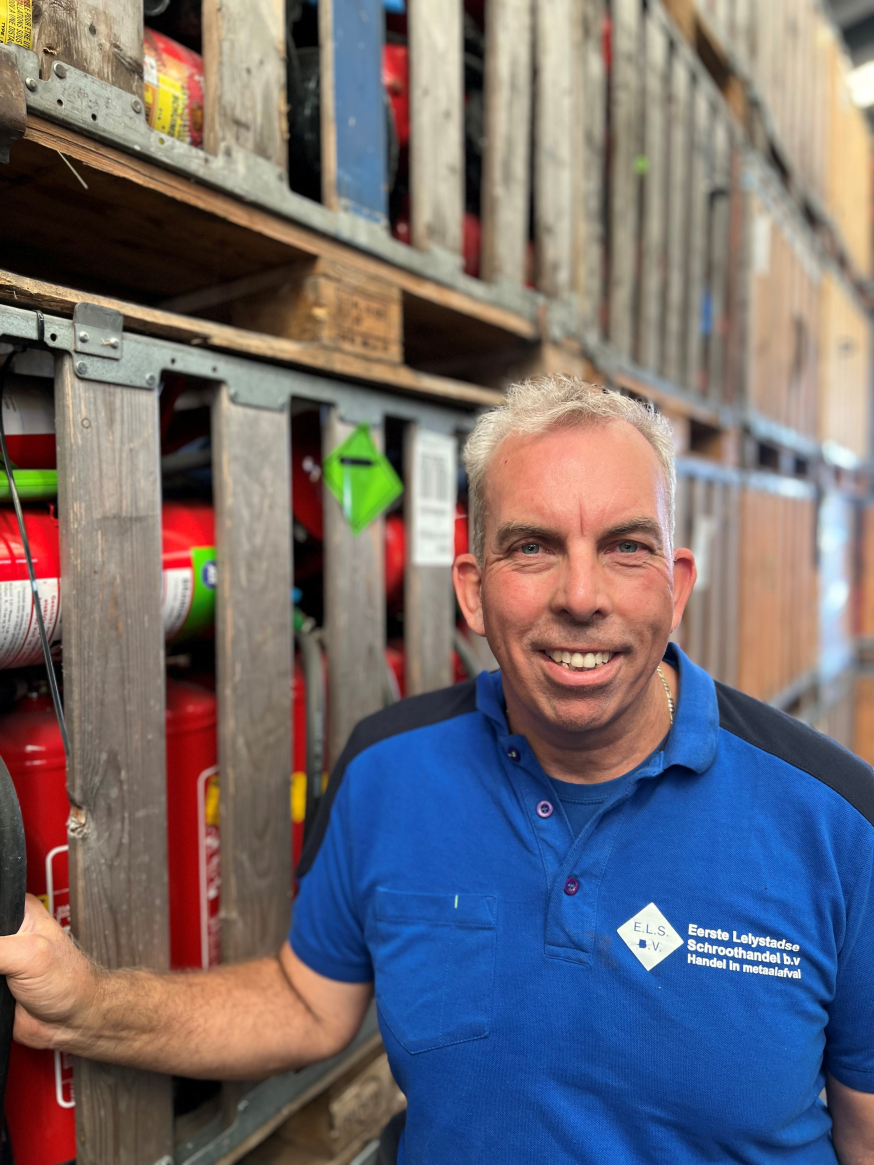
Arjan Van 't Wel
Van 't Wel knows: 'Then they threaten to disappear across the border. To countries where the regulations are not so strict. There you already see that discarded extinguishers disappear into a shadowy world that touches on the underworld. Recycling there equates to emptying them out in a shady industrial area. Then everything ends up in our groundwater. That pollution does not stop at the border. Sooner or later, we will have to deal with it. And then it is no longer about a kilogram...'