
This pattern needs to be broken. Not by making HR larger or more complex, but by fundamentally organizing it more simply. 31% of entrepreneurs see opportunities in digitization and AI, but do not know how to implement them effectively. The need for solutions that save time and provide clarity is growing.
A different perspective on HR and payroll
HR and payroll must adapt to SMEs without extra layers or complexity. By simplifying processes, employees can manage more themselves, entrepreneurs maintain oversight, and there is room for accounting firms to apply their knowledge where it adds the most value.
'HR and payroll have been built up for too long as separate actions,' says Marc van Gaal, director of Loket, HR and payroll platform. 'We believe it can be done differently: organized more simply, with technology that supports in the background. This way, people maintain control but do not have to do everything themselves.'
Accounting firms as an extension of SMEs
For many SME organizations, accounting firms have been a trusted point of contact for HR and payroll issues for years. The 'Annual Report State of SMEs 2025' shows that there are about 200,000 SMEs in the Netherlands waiting for guidance on process improvement or digitization, while only 13% currently apply AI to improve processes. Numbers that call for support from an advisor who is close to the entrepreneur.
The role of accounting firms is shifting: less operational work, more room for guidance, advice, and continuity. Loket sees firms not as users of software, but as partners in strengthening SMEs. By developing and improving together, a way of working emerges in which firms deepen their role: less operational, more advisory, and closer to the entrepreneur.
Also read: Cheaper is not always smarter: 3 lessons on pricing strategy for entrepreneurs
A clear course for SMEs
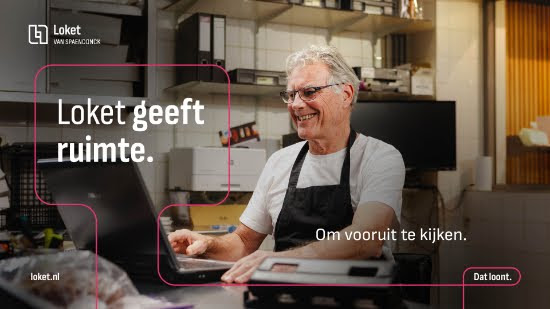
This development comes together in the renewed positioning and brand identity of Loket. The core of that choice: to organize HR and payroll in such a way that they give back time instead of demanding attention. Not the separate functions are central, but what SMEs need to make good employment practices a matter of course.
Every employee a HR buddy
Concretely, this course is visible in Loket's digital HR assistant: a personal 'HR buddy' for every employee. Employees ask questions ('My father has passed away, how long do I get off?') or arrange something directly ('I want to submit my expense report'). The assistant not only provides answers but also helps with execution and documentation according to the organization's agreements. HR maintains oversight and control, while recurring questions and individual requests take less time.
In the next phase, this support will become even more accessible. Employees will then be able to have live conversations with the HR assistant, as if they are calling a colleague. From leave to expense reports and insight into employment conditions: everything in one conversation, processed immediately. Not a chatbot, but a smart digital buddy that thinks along and takes work off their hands.
Also read: Lightspeed Commerce reveals product innovations designed to help entrepreneurs work smarter
Good employment practices as a matter of course
When HR and payroll are logically organized, there is room for attention, development, and growth. Not by working harder, but by organizing work smarter.
Also read: Dutch SMEs use AI to compete with giants: entrepreneurship on the rise